There are days when, standing before a scan or a histopathology slide, we see cancer as a mass of matter: it has borders, size, and location. We cut it out. We burn it. We make it smaller. And yet, after a few quiet years, it may return—elsewhere, in another form, with another “personality.” Modern science forces us to look deeper. Cancer is not merely a tumor. It is a biological operating system of the cell that has been misprogrammed.
If we imagine the body as a city, each cell is a house with its own control panel. Under normal conditions, that panel knows when to turn the lights on, when to shut machines down, which rooms to activate, which to power off, and when to cut the main supply to prevent a fire. A cancer cell is different. It bypasses the safety brakes, adds backup wiring, and installs a “never shut down” mode—removing the fuses. Molecular biology calls this a cellular signaling network. Here, we describe it more plainly: the “command circuit board of cancer.”
A cancer cell lives by “faulty commands.”
A cancer cell does not grow in silence. It receives commands—transmits commands—and executes commands. From the surrounding environment—oxygen, nutrients, cytokines, immune cells—through receptors on the cell membrane—along signaling pathways in the cytoplasm—into the nucleus—switching genes on or off—
and finally becoming acts of life: to divide or not to divide; to live or to die; to stay or to migrate; to grow new blood vessels or to starve; to lie dormant or to relapse years later.
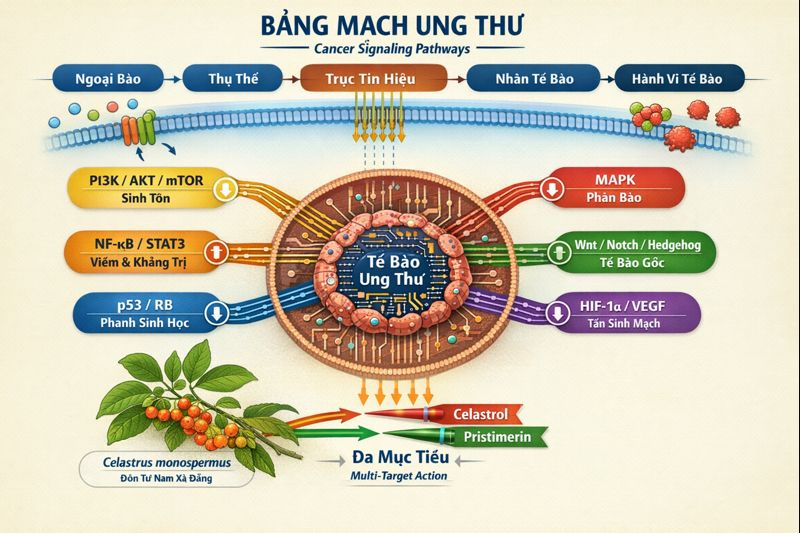
If we treat the cancer cell as a living electronic system, then six core signaling axes are the main circuits on its “biological motherboard.” Along these tracks, molecular “chips” such as AKT, mTOR, STAT3, β-catenin, or p53 continuously receive, process, and send out commands that decide whether a cell will survive, divide, resist death, or self-destruct.
There is a line that tells the cell: “Eat, grow, do not die.”
There is a line that orders: “Keep dividing, keep multiplying.”
There is a command that says: “Become drug-resistant, pump toxins out of the cell.”
There is a line that preserves the seed: “When most are dying, cancer stem cells—run, hide, hibernate, and pretend to be dead.”
There is a braking line: “Stop, repair the brakes, or crash and die.”
And there is a supply line that orders: “If oxygen is low, grow new blood vessels.”
Molecular biology gives these pathways technical names: PI3K/AKT/mTOR, MAPK, NF-κB/STAT3, Wnt/Notch/Hedgehog, p53/RB, HIF-1α/VEGF.
Why does the system keep running when one wire is cut?
In modern therapy, we are increasingly skilled at cutting a single wire, hitting a single target: blocking a receptor, inhibiting an enzyme, or shutting down one signaling pathway.
But the biological circuit board of cancer is not a single wire. It is a network with detours, shortcuts, and backup routes. Cut one path, the current flows through another. Block proliferation, it switches to anti-death mode. Block blood vessels, it increases invasion into vascular-rich areas. Destroy the main tumor, it preserves “cancer stem cells” (CSCs)—the “seeds” waiting for relapse. This is why resistance and recurrence always accompany oncology.
Where do East and West meet?
Modern medicine says: cancer is a disease of disordered signaling networks.
Traditional medicine says: cancer is a disease of global systemic imbalance.
Different languages, but a very similar essence: there is not a single “enemy” to destroy, but a system that must be re-regulated. When vital energy is preserved within, pathogenic forces cannot invade. When the internal biological structure is balanced and stable, harmful influences struggle to take hold.
The Eastern way of thinking:
An illustration using the medicinal plant Đơn tử nam xà đằng and the concept of “multi-compound – multi-target” action. In nature, a medicinal plant rarely contains only one active compound. It is more like an orchestra than a single note.
Đơn tử nam xà đằng — Celastrus monospermus — is a typical example. This plant contains at least two prominent compounds: celastrol and pristimerin. What is remarkable is not merely their “strength” or “toxicity,” but how they strike multiple command keys at once:
- On the survival axis, they weaken PI3K/AKT/mTOR—pushing the cell into “energy starvation” and making it prone to programmed death.
- On the inflammation–resistance axis, they inhibit NF-κB and STAT3—reducing “do not die, resist drugs” signals.
- On the proliferation axis, they interfere with MAPK/ERK—slowing the rhythm of cell division.
- On the cancer stem cell axis, they affect Wnt/β-catenin—weakening the “seeds of recurrence.”
- At the same time, they activate caspases and p53—partially restoring the “biological brakes” that have been cut.
Here, the story is no longer “one drug – one target,” but one plant – many compounds – many signaling axes – many targets. According to available literature, this plant affects 26 types of cancer. Although it is less potent than Tripterygium wilfordii Hook.f. (Lôi công đằng), they belong to the same family, Celastraceae R.Br., and both exert strong multi-compound, multi-target effects in cancer.
According to the doctrine of natural biosynchronization (the unity of Heaven and Humanity), where there is disease, there is also a remedy in its own way. This philosophy anticipated multi-target thinking long before modern science gave it a name.
When the circuit board becomes the shared language of cellular life:
In the laboratory, we speak of proteins, kinases, transcription factors, genes. In the traditional clinic, we speak of vital energy, meridians, blood flow, body structures, and pathogenic forces.
But if we look deeper, both East and West are pointing to the same thing: a disorder of life’s signaling system.
Not to replace one another, but to complement each other within a complex, integrated system.
Conclusion:
Cancer is not merely a mass to be removed. It is a disorder of biological signaling that needs re-regulation. When we begin to see the cancer cell as a system in operation, rather than only an object to be destroyed, treatment ceases to be a one-sided battle—and becomes a strategic process of intervening in the very “operating system of balance that governs life.”
Dr. Hoàng Sầm
Chairman, Vietnamese Institute of Indigenous Medicine